
On super-exponential AI acceleration, the failure of catch-up thinking, and what communications must become when the ground moves faster than the plan.
“It is exhausting.” That is how an AI engineer described it to me. How do you keep up with something that is getting exponentially more intelligent on a curve that continues to bend upward at an angle that, if you let yourself think about it, should make you spit out your coffee?
The skeptic will say: Doesn’t every era have one? An inflection point that looks like an S-curve, sharply vertical before it levels off. The Gutenberg press was transformative across a century. The Industrial Revolution reshaped civilization across three generations. Even the internet’s explosive growth described the spread of a tool with fixed capability. But as concerns AI, this is not a faster horse. It is an entirely different animal, one that we have no idea how far or how fast it can run. No idea. We do not even understand how it works, not really.
And yet — the exhaustion itself is a clue. It is not evidence that the change is too great to manage. It is evidence that we are approaching it incorrectly.
Look at what actually happened at each of those prior transitions. No organization that survived the Industrial Revolution did so by accelerating hand production. No company that thrived in the internet era did so by printing faster catalogs. In every case, the architecture changed. Not the pace. The structure. The companies that endured built operating systems suited to the new conditions — and once those systems were in place, they could absorb the next wave without having to start from scratch each time. Adaptation was not a crisis. It was the design.
This is the part we keep forgetting, because the scale of the current change makes us feel that something new and unprecedented must require a response that is itself entirely new and unprecedented. But the principle is older than any of these revolutions. Heraclitus, in the fifth century BCE, wrote that the only constant is change, as an architectural observation. The question has never been how to stop the river, but rather how to build something that floats.
The exhaustion comes from treating each new AI capability release as a problem to catch up with, rather than building a structure designed to accommodate change as its permanent operating condition. We are still trying to cross a river that has decided to move.
Which brings us to what is structurally different this time, and this part does matter, because the architecture you build has to be proportionate to the nature of what it is absorbing.
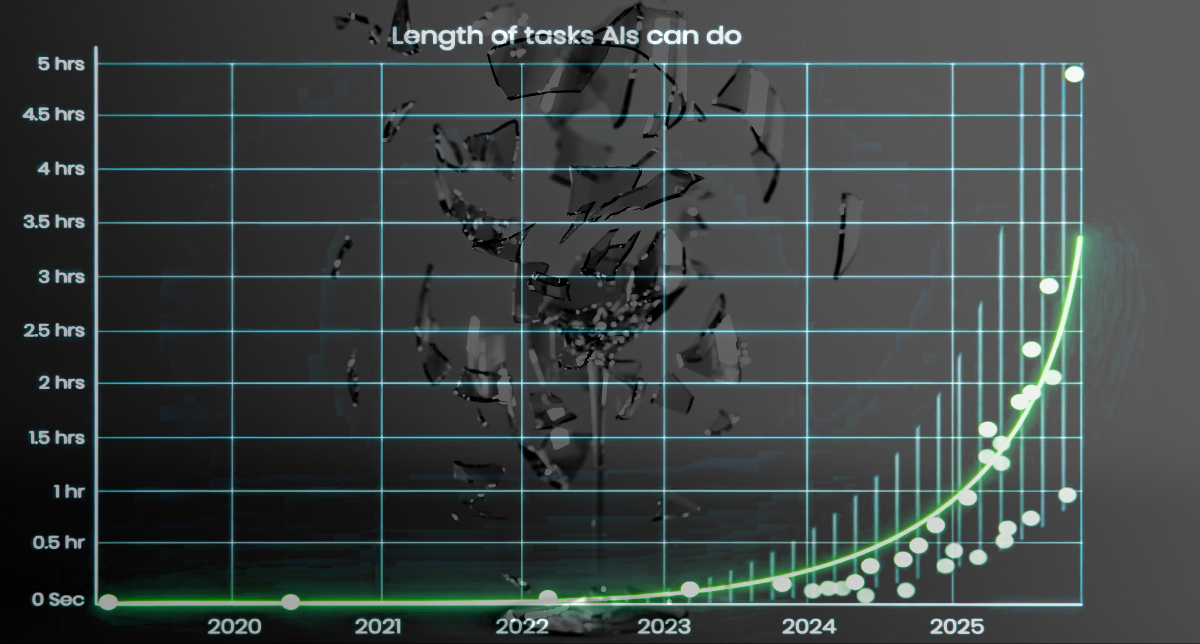
As I prepared my notes and researched how this will impact business generally and communications in particular, discussions kept returning to Moore’s Law, the observation that microprocessor complexity and processing power roughly double every 18 months. But, this is nothing like it. Moore’s Law was exponential with a fixed exponent. A reliable doubling interval that allowed an entire industry to plan sixty years of roadmaps around a single, stable rate of change. AI acceleration is compressing that interval with each iteration: from seven months to four months across 2024 to 2025, with credible projections pointing toward three months by the end of this year. It is not only doubling. It is halving the time frame in which it does so. The curve has a curve.
This is the inflection point that is structurally different from what most organizations think they are managing. The difference between exponential and what comes after exponential is not a rounding error. It is the fault line between strategies that are inadequate and strategies that are obsolete before they are implemented.
The curve is not simply steep. The rate at which it is getting steeper is itself accelerating.
In mathematics, this is called super-exponential growth, or hyperbolic growth in its more extreme forms. What distinguishes it from ordinary exponential behavior is that the doubling interval is not fixed but shrinking. The curve does not have a ceiling to aim for, nor does it self-correct toward a plateau. It compounds the compounding, and it does so on its own.
Paul Virilio spent a career articulating what this kind of dynamic does to human experience. His concept of dromology described speed not as a property of objects moving through a stable world, but as the governing logic of modernity itself. At a certain threshold, he argued, speed stops being a means and becomes the environment. We are not moving faster through a landscape that holds still. The landscape is the speed. What changes around us changes faster than we can build categories to describe it. That is where we are. And most of the strategies I see were written for somewhere else; this is especially true, and it starts with communications.
Here is the practical consequence that strategy has been the slowest to absorb. In a normal exponential environment, you can engineer a response that is perpetually catching up. You accept a structural lag, maybe six months, a year, and you build a buffer into your planning accordingly. You treat the gap between capability and capacity as a manageable constant. Organizations are very good at tolerating manageable discomfort. They have been doing it since the Industrial Revolution.
But when the doubling interval itself is shrinking, last quarter’s lag is already wider this quarter. By the time a twelve-month transformation program delivers its first output, the capability gap it was designed to close has tripled. The strategy is obsolete before it is implemented.
By December 2025, frontier AI models could sustain task assignments running up to four and a half months in duration. These were demonstrated benchmarks. In early 2023, those same systems operated in the range of minutes. If the four-month doubling interval holds through this year, AI capable of sustaining month-long complex autonomous assignments could arrive in 2027 — two years ahead of what the conservative projections published eighteen months ago were willing to say out loud.
The seventy-five percent of employees who already believe their skills will become obsolete are not being irrational. They are performing a broadly accurate calculation on incomplete data. The reality, when the full compression is applied, is more acute than what they are imagining.
I am not writing this as an argument for alarm. I am writing it as an argument against using planning frameworks calibrated for a world in which the ground moved slowly enough that you could measure the speed, draw up a response, and implement it before the measurement was out of date. That world is gone. The question is how many organizations will notice before the gap becomes structural.
There is something that organizations prefer not to say out loud, so I will say it here.
The human cognitive system was not designed for this environment. We are, neurologically, linear creatures. Our threat detection evolved for predators with physical signatures and temporal horizons measured in seconds. Our planning capacity developed in environments where the future resembled the recent past with minor, predictable variations. Our emotional processing runs on timescales of hours to weeks. We are, in every measurable biological sense, calibrated for a world that no longer exists.
This is a design observation. And like all design observations, it points toward a design problem.
Daniel Kahneman spent decades documenting the architecture of human cognition: System 1, fast and associative, running on pattern recognition; System 2, slow and deliberate, capable of analysis. Both systems are linear in their processing assumptions. Neither was built to operate in conditions where the pattern itself changes faster than the recognition cycle completes. You learn the rule. The rule changes. You learn the new rule. The new rule changes. At each iteration, the cycle is shorter than the last. This is not to be confused with information overload, a concept we developed in the 1970s for which we have built reasonable coping mechanisms. Rather, it is pattern instability: the schema through which we navigate reality becomes unreliable before the next decision begins.
Byung-Chul Han diagnosed something adjacent in his work on the burnout society. Han argued that the pathology of late modernity is not oppression from without but excess from within: excess of positivity, of optimization imperatives, of the obligation to perform capability at every moment. The acceleration of AI does not resolve that excess. It multiplies it geometrically, then accelerates the multiplication. The pressure to adapt continuously at a pace the nervous system was not built to sustain produces a specific kind of cognitive exhaustion that is not solved by resilience workshops.
Bernard Stiegler, in his work on tertiary retention and the pharmakon of technology, offered a frame that cuts even closer. Every technical prosthesis, he argued, is simultaneously a remedy and a poison. It extends human capacity in one dimension while atrophying it in another. AI as a pharmakon does not simply augment cognition; it also shapes what cognition is called upon to do, and what it gradually stops being asked to do at all. The risk is not that we become dependent on the machine; it is that we become unaware of what the machine is taking over, until the moment when we need to reclaim it and find that the capacity has not been maintained.
This is where we encounter the failure of the faster horse. The instinctive organizational response to acceleration is to accelerate the response. More agile methodologies. Shorter sprint cycles. Faster hiring pipelines. Continuous training programs. These are not necessarily wrong. But they are solutions optimized for a problem that is one order of magnitude simpler than the one we are actually facing.
The aphorism attributed to Henry Ford is overused, but its structural logic remains sharp. When the environment changes categorically, improving the existing solution does not merely fall short. It actively redirects energy and attention away from the questions that have become more urgent.
The question that matters is how we build systems whose fundamental operating assumption is that the landscape will change before they finish crossing it. Moving faster through the landscape, in this case, is simply moving faster to our own obsolescence.
This requires a different kind of thinking than most organizations are currently doing. It requires moving from transformation as a project to recalibration as a permanent structural condition. The difference is not semantic. It is architectural. One model assumes the organization moves through change and arrives somewhere. The other assumes the organization is in change, and that arrival is a category that no longer applies.
Hannah Arendt, writing about action in The Human Condition, drew a distinction that applies directly here. What we are being asked to do, as organizations and as communicators, is to learn to act, in Arendt’s sense, to move into conditions of irreducible uncertainty without the guarantee of a stable outcome, and to build the shared language that makes collective action under uncertainty possible.
A pattern of what works and why it works has emerged that surprised me when I first began to see it clearly.
The organizations navigating this period most effectively are not the ones with the most sophisticated AI implementations. Several of them have genuinely modest infrastructure. What they share is something harder to install than software: they have stopped treating stable state as the goal, and replaced it with continuous structural recalibration as the operating discipline.
n concrete terms, this means that decision-making cycles have been decoupled from planning cycles, human judgement has been repositioned – not eliminated, and the capacity for redesign has been partially automated.
Communications, in this context, is not a function that sits adjacent to the acceleration problem. It is the medium through which organizations process their own adaptation.
Every cultural shift moves through communication before it moves anywhere else. If the communication architecture operates on a monthly or quarterly cadence, the organization cannot adapt faster than that cadence allows. The communication system is the rate limiter. That is a technical expression, but it is the right one: in computing, the rate limiter is the component that determines the maximum throughput of the entire system, regardless of the capacity of every other component.
The strategic question for every communications leader right now is not which AI tools to adopt. It is about redesigning the function itself as a continuous, real-time signal-processing system rather than a periodic broadcast mechanism.
This means, in practice, that narrative management, which was once conducted through annual employee surveys and quarterly town halls, needs to move toward continuous sentiment analysis and adaptive messaging. Stakeholder communication built on fixed relationship mapping needs to become dynamic, updating as positions shift and as external conditions change the meaning of what was said last week. Crisis protocols designed for discrete events need to extend into managing what is now, effectively, a permanent condition of low-grade uncertainty punctuated by acute episodes.
The communicator’s job in this environment is to build the shared cognitive infrastructure through which an organization can remain coherent as it continuously changes. That is a different discipline. It requires a different set of skills. And it requires a willingness to redefine what communication is for at a structural level, rather than adding AI tools to a function that is still organized around assumptions from a different era.
Communication is not the way we announce decisions. It is the operating system through which decisions become real. If the operating system cannot handle the update frequency the environment demands, it slowly degrades, in ways that cause organizations to become progressively less able to recognize what is happening to them — until recognition itself arrives too late to be useful.
Seneca wrote to Lucilius: nusquam est qui ubique est. To be everywhere is to be nowhere. He was writing about distraction, about the cost of dividing attention across too many surfaces simultaneously. But the sentence fits differently in 2026.
The acceleration we are living through creates a specific temptation: to respond to every new capability, every new threshold, every new tool with immediate absorption. To be everywhere the curve goes. To treat acceleration as a moral obligation rather than a structural condition to be navigated thoughtfully.
This is a trap because undifferentiated adaptation produces organizations and individuals who are perpetually responsive and never coherent. You can move so fast that you lose track of what you are moving toward, and what you are choosing not to become. Aristotle called the failure to act in accordance with one’s own best judgment akrasia, weakness of will, the gap between knowing and doing. What super-exponential acceleration introduces is a new form: a collective akrasia, in which the organization knows the question it should be asking, but the pace of the environment makes the asking feel like a luxury it cannot afford.
Albert Camus, in The Myth of Sisyphus, argued that the fundamental philosophical question is whether, in a world stripped of stable meaning, life is worth living. His answer was yes — not because meaning is given, but because it is made, continuously, in the act of choosing what to do with the conditions we did not choose. The organizational equivalent is no less serious. In an environment where the capacity to execute almost anything has been radically democratized by AI, the differentiating factor is no longer execution speed. It is clarity of purpose under conditions of permanent uncertainty. The question of what we are building, for whom, and at what cost to what we value does not go away just because the machine gets faster. It becomes more urgent.
The organizations and communicators who navigate this period well will be the ones who knew, with some precision, what they were adapting toward and who built the structural capacity to keep asking that question as the answer changed.
The curve has no ceiling, but the people navigating it still do.
That asymmetry is the condition of being human inside a technological moment that outpaces human tempo. Acknowledging it clearly is the beginning of a more honest strategy than most organizations are currently willing to have.
Leave a Reply
You must be logged in to post a comment.