
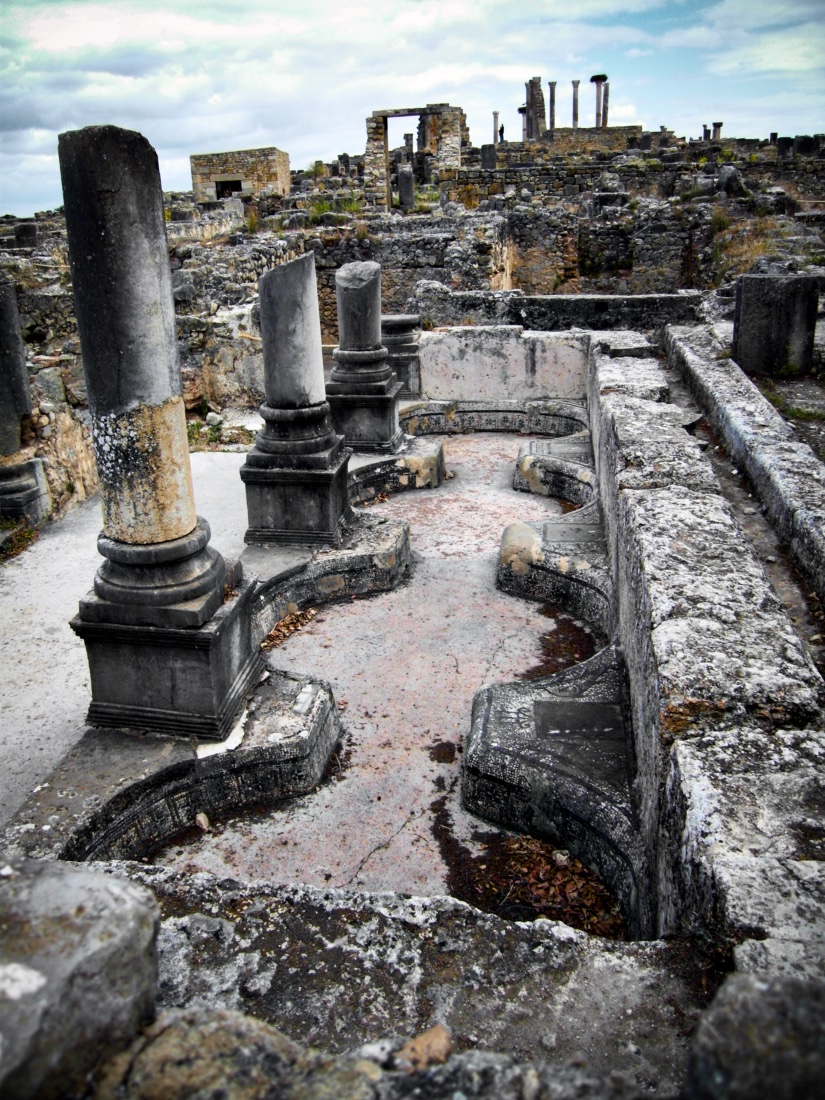
There are moments in our lives, as there are in stories, that deserve more time than we give to simply reading the words themselves. The story of Elissa is one of these.
Elissa had just fled Tyre. Her brother Pygmalion had murdered her husband and seized the throne. She took what she could: a loyal circle, a cache of gold, the temple priest of Astarte, and sailed west into a sea that most people of her era treated as a wall rather than a road. She was not the first Phoenician to do that. Her people had been threading these waters for three centuries already. But she was the first to plant a universe of new ideas permanently on the North African shore.
When she arrived and negotiated for land with the Berber king Hiarbas, she asked only for as much ground as could be covered by an ox hide. He agreed, assuming he was being generous to a refugee. She cut the hide into strips so thin they could encircle an entire hilltop. The city she traced on that hill became Carthage. Qart-Hadasht in Phoenician. The New City.
The Phoenicians are the most underrated civilization in the Western tradition, but like the Assyrians, they are often overlooked because they did not build enduring monuments. They also did not write epics that became school curricula. What they did build was at least just as significant, though. They built a network of over 300 coastal colonies from the Levant to the Iberian Peninsula, connected by ships that could go farther and carry more than anything their rivals had. They invented a functional alphabet, which is so much more than a mere literary project; it is the architecture upon which those projects can be built. It became the first CRM. Merchants needed to record transactions faster than cuneiform allowed, and so they simplified. Twenty-two characters, multi-platform OS. Adaptable to any language. Even the Greeks borrowed it. Then the Romans borrowed it from the Greeks. Regardless of whether you are shaking your head or about to put down this article for something else, you are reading its direct descendant right now.
This is the thing about the Phoenicians: they were not empire builders like so many before and after them; they were network builders. Contrary to the empires of the time, their power was relational and informational. Whether it was knowing the routes or holding the chokepoints, they understood that the real currency of the ancient Mediterranean was not tin or grain or purple dye, though they traded all of those; it was knowing what others did not know and being capable of what others were not.
Carthage grew from that logic. By the third century BC, it was the second-largest city in the Mediterranean, behind only Alexandria. Its fleet dominated western trade. It had embedded colonies in Sardinia, Corsica, Sicily, and Iberia. It was far more than a single monolithic power directed from a throne. It was a distributed system, with semi-autonomous nodes operating under shared commercial incentives. It had managed to survive centuries of pressure from Etruscans, Greeks, and the slow consolidating rise of Rome to the north.
I hope you are enjoying the story thus far, and don’t worry, we are nearing the last chapter.
So now imagine that we have moved up in time to when Rome decided it could no longer tolerate a distributed, adaptive, commercially dominant rival operating across the sea.
The Punic Wars, three of them, spanning 118 years, are usually taught as military history. Hannibal crossed the Alps with war elephants. The double envelopment at Cannae. Scipio’s eventual victory at Zama. But that framing misses what was actually being decided. These were not territorial wars in the traditional sense, even if they looked horrifically familiar. They were a contest between two fundamentally different theories of power.
Rome’s theory: centralized command, standardized structure, scalable legions, unified law, and the conviction that the only stable world is one where everyone operates within “your” system.
Carthage’s theory: adaptability, commercial sovereignty, distributed nodes, and the belief that a network of capable autonomous actors is more resilient than any monolithic structure.
I think you are starting to suspect where I am going with this. But bear with me for a couple more paragraphs.
For most of the Second Punic War, Carthage’s theory was winning. Hannibal crossed the Alps because it was unexpected, even so far from the most direct or practical route. He fought in Italy for fifteen years without a fixed supply line, because he had built an army capable of sustaining itself from the environment. At Cannae, he faced a Roman force nearly double the size of his own and destroyed it with a double envelopment, one of the most studied tactical moves in military history, precisely because he refused to fight Rome on Rome’s terms. He adapted. Constantly.
Students of history will now shake their heads at me because even if they won, Carthage still lost.
Not at Cannae. Not even at Zama. It lost across decades, because the Roman state was willing to absorb catastrophic short-term losses in the service of a long-term structural objective. They had the winning architecture. Rome rebuilt its navy from scratch after the First Punic War, it had no seafaring tradition, so it captured a Carthaginian ship and used it as a template. It adapted too, but it adapted to eliminate rather than to compete. In 146 BC, after the Third Punic War, Rome did not occupy Carthage. It burned it for seventeen days. It leveled the foundations. It salted, according to some accounts, the earth. It wanted to ensure that no one could ever rebuild on that site and become that kind of rival again.
The phrase “Carthago delenda est”, Carthage must be destroyed, had been a political mantra for years before the siege. Cato the Elder reportedly ended every senate speech with it, regardless of the topic. It was not really about Carthage anymore. It was about the refusal to allow an alternative model of civilizational organization to persist.
Ok, so finally here we are, the point I am trying to make, and you are forgiven if you skipped over the “super fun” trip through history to get to it.
If you have spent any time thinking about what is happening with AI right now, the echo should be loud enough to ring between Tunisia and Sicily.
We are living through a moment that maps with precision onto the late third century BC.
On one side, you have two or three large centralized systems built by organizations with near-unlimited compute, trained on effectively all of human writing, distributed through controlled APIs, operating under terms that route your data, your queries, your dependencies, back through a single point of control. They are genuinely impressive. They are also structurally Rome. Scalable. Standardized. Oriented toward total absorption.
On the other side, you have something much younger and considerably messier: local AI. Models that run on consumer hardware. Inference stacks that stay within your own infrastructure. Systems that you own, that see only what you show them, that can be fine-tuned on your actual context rather than the average of all human production. Ollama. llama.cpp. Small, capable models from Mistral and the growing open-source ecosystem. The Phoenician alphabet of the present is practical, adaptable, and not beautiful in the way cuneiform was, but powerful precisely because anyone can use it.
The instinct in most organizations is to centralize. Buy the enterprise license. Route everything through the API. To consolidate in the hopes of being efficient, and managers come across as being decisive. AND it mirrors what Rome always told itself: that unity and standardization are the conditions of strength.
BUT Hannibal already disproved that. His army, operating without a fixed base in hostile territory for fifteen years, was not a symbol of chaos that so many see in emerging AI today, but rather a demonstration that a sufficiently adaptable distributed system can outperform a monolithic one in almost every tactical engagement. He just could not outlast Rome’s institutional patience and its willingness to absorb the cost of eliminating him as a model.
What does this mean for us as we consider how to integrate AI right about now? For anyone building something they still want to own in a decade, it’s not about “which model is best.” It is: are you building a network or becoming a dependency?
Elissa did not build a replica of Tyre. She did not try to reproduce the city she came from. She read the geography of the North African coast; she understood what was available; she negotiated within the constraints she had; and she built something new, informed by Phoenician principles without being limited to Phoenician form. The ox hide trick was a problem-solving under constraint.
Some tend to see Local AI as a consolation prize for people who cannot afford the big models. It is a different design philosophy. Data stays inside your perimeter. Latency disappears. Inference costs approach zero after the initial hardware investment. Your institutional knowledge, the documents, the conversations, the decisions that make your organization what it actually is, can become part of the model without ever leaving your control. You are no longer a customer; you are much more: an operator.
The companies and individuals building this way right now are doing what the Phoenicians did when the Assyrian and Persian empires were pressing against their eastern borders: they played the dominant powers where they had to, and they built independently where they could. They did not resist the empires frontally. They maintained the parts of their network that the empires could not easily reach.
Adaptability is not the same as compromise. The Phoenicians were not weak because they moved laterally around power. They were strong precisely because they understood that network resilience depends on not putting everything under a single point of failure.
Carthage fell because it eventually had to fight Rome frontally. It had no choice. The wars came to it. And when you fight a centralized monolith on its own terms, the monolith usually wins.
The lesson is not that distributed systems always lose. It is the moment a distributed system stops adapting and starts imitating the structure of the power it is competing with that it loses the only advantage it ever had.
The AI landscape in 2026 is not yet 146 BC. We are, if anything, somewhere in the middle of the Second Punic War. The outcome is not written. There are organizations and individuals right now building real, sovereign AI infrastructure, and they are doing so because they understand that owning your inference, your context, your knowledge layer is a structural advantage that compounds over time.
Elissa cut the ox hide into strips because she understood the problem. She was trying to get enough ground to build something that would outlast the conversation.
What are you actually building, and how thin are you willing to cut the strips?
Leave a Reply
You must be logged in to post a comment.