The Wisdom We Didn’t Earn: AI, Experience, and the Knowledge That Only Hurts to Get
”Your worst sin is that you have destroyed and betrayed yourself for nothing.”
Because of the title of his book, many believe that Dostoevsky wrote that line about crime, moral collapse, or dramatic ruin, as in this specific scene, Sonya is criticized for being a prostitute. You would be wrong in supposing this, for he was expressing the ordinary, everyday choice to take the easy path when the hard one was what you needed. The betrayal he had in mind is what we all feel when we surrender. It is not usually dramatic; it is simply the betrayal of a small shortcut that avoids the difficulty, which in the end was the whole point.
I have been thinking about that line a lot lately, specifically in the context of watching very smart people hand their thinking over to a machine and walk away feeling sharper than before.
There is a Greek word you will not find in any AI prompt guide: phronesis. Aristotle used it to describe practical wisdom. This is the kind that tells you not just what is true but what to do about it, in this situation, with these people, under these particular pressures. He distinguished it carefully from episteme, which is theoretical knowledge, the kind that can be demonstrated, taught, written down, and passed across a table.
To simplify for our purposes: Episteme, you can hand someone. Phronesis, you cannot.
Aristotle was blunt about this: practical wisdom “cannot be directly taught through instruction.” It is acquired through experience, reflection, failure, and the slow accumulation of consequential judgment. 1 2
AI is very good at episteme. It is structurally incapable of phronesis.
Before everyone applauds for putting AI in its place, this is not a criticism. I am making an observation, a description of where AI stands now in this moment in time. This is a distinction that matters more than it ever has, because we are increasingly living as if the two were interchangeable — as if having access to an answer were the same as having earned the understanding behind it.
It is NOT.
Michael Polanyi, a physical chemist who became one of the twentieth century’s most important philosophers of knowledge, spent his career trying to articulate something that most organizations systematically ignore. He called it tacit knowledge. His formulation was simple and devastating: we know more than we can tell. 3 4
What Polanyi meant was that most of what constitutes genuine human competence cannot be fully articulated in verbal form. It lives in the body of the dancer. It lives in the hands of the plumber. It lives in the dark crevices of the mind of the writer. It lives in the accumulated texture of having been wrong and learning from it, often at the most inconvenient times, while accompanied by real consequences. Researchers estimate that between 70 and 80 percent of organizational knowledge is tacit in this sense: unwritten, experience-based, and resistant to codification. 5 6
Read that again, 70 to 80 percent. This is important.
AI attempts to overcome Polanyi’s paradox by statistically absorbing how humans communicate. What it produces is an impressive approximation. But approximation is not understanding. A 2025 (yes, lots have changed in a year, but this is the closest I could find) study in Nature confirmed that even the most advanced AI models remain structurally “unable to engage in abductive reasoning, grasp analogies and metaphors, or interpret sparse or nuanced data.” The system has no body, no history of having been wrong in a way that cost it something. 7 8
To the critics out there, this is not AI’s failure. This is what AI is.
The problem is that we are beginning to confuse what AI gives us — episteme (fluent, confident, well-organized) — with phronesis (the harder, slower, more bruising process by which humans actually develop). And if we do that consistently and hand that confusion to a generation that has never known anything different, we are not giving them a shortcut. We are robbing them of the road to fulfilling human existence.
Nietzsche was not gentle about this. In The Gay Science, he wrote that no one “is able to produce a great work of art without experience, nor achieve a worldly position immediately, nor be a great lover at the first attempt; and in the interval between initial failure and subsequent success, in the gap between who we wish one day to be and who we are at present, must come pain, anxiety, envy and humiliation.” He was correcting what he called a ruinous belief: that fulfillment should come easily or not at all. The belief that leads us to withdraw from challenges at precisely the moment they were about to teach us something.9
He was not making a case for suffering as an end in itself. He was making a case for what suffering produces nothing else can.
The learning scientists call this desirable difficulties.
Robert Bjork, whose research on memory has shaped cognitive psychology for decades, showed that conditions that feel like they impede learning actually produce stronger, more durable encoding than practice that feels easy. Manu Kapur’s research on productive failure goes further: students who were made to struggle with a problem before being given instruction on how to solve it consistently outperformed students who received direct instruction first, on every measure of conceptual understanding and knowledge transfer. 10 11 12
The struggle is not incidental to the learning. The struggle is the learning.
Vygotsky understood this, too. His concept of the zone of proximal development describes where genuine cognitive growth happens. In the productive, effortful, uncomfortable middle, where the task is slightly harder than you can currently handle. Not in the comfort of what you already know. 13 14 15
AI, used as an “answer oracle” more prominently than the Delphi, but without the wisdom, evacuates that zone completely. It takes the student from question to solution without passing through the struggle. And the student’s brain, registering the fluency of the AI-generated answer, mistakes the ease of reading it for the depth of having understood it.
In 2026, researchers at the University of Technology Sydney and the University of Queensland published a report that named this mechanism with unusual precision. They called it the performance paradox. 16 17
Their central finding: students using AI perform better on immediate tasks. But their durable learning goes down. In the most striking study they cited, nearly a thousand high school mathematics students used AI tools to work through problems. Performance looked fine. Take the AI away, and the learning simply was not there.18
The mechanism they identified is what they called metacognitive laziness. AI output is fluent and confident. It feels correct. Students process it easily and, in doing so, mistake the ease of processing for actual understanding — what the researchers describe as a false mastery with potentially long-term consequences. 19 20
This is not a new insight, exactly. A 2025 study from Aalto University followed participants solving logical reasoning questions from the Law School Admissions Test. Those who used AI scored an average of three points higher than those who did not. They also overestimated their performance by an average of four points. In other words, they did better and thought they did even better than that. They became, in the study’s precise phrasing, smarter but none the wiser. 21 22
What is especially unsettling about this research is the correlation inside it: higher AI literacy was associated with lower metacognitive accuracy. People who know more about how AI works trust their AI-assisted performance the most and assess it the least accurately. This is the Dunning-Kruger effect running in reverse, driven not by ignorance but by the simulated competence the tool provides. 23 24
Wisdom, among other things, is calibrated humility. A true sense of where your understanding actually ends. AI, used passively, pushes directly against that.
Here is where this gets serious.
90% of Gen Z use AI tools in 2026. Eighty percent of Gen Z professionals use AI for more than half of their daily tasks. Among young people aged 15 to 17 in the United States, more than half have already used generative AI applications. And the Gen Z writer at Stack Overflow described the trajectory of her own generation without any sentimentality: declining attention span, combined with AI tools for learning, creates “a compounding negative effect on people my age that we’ll probably be digging ourselves out of for the rest of our lives.” 25 26 27
Sixty-eight percent of Gen Z adults are themselves anxious about this. They are worried that offloading cognitive tasks to AI means missing out on the very experience of learning. As a member of Generation X, I would have to say they are not wrong to be worried. Indeed, I used swing sets without a helmet, which brought its own kind of wisdom. Interestingly, Gen Z’s negative sentiment toward AI’s effect on learning has grown sharply: by April 2026, 74% of K-12 Gen Z students said AI completing tasks faster “will make learning more difficult in the future,” and 83% of Gen Z adults agreed. 28 29
The UTS/UQ report describes a specific and serious risk for novice learners, defined by UTS/UQ as students who are in the process of building the foundational knowledge structures that all later, more complex thinking depends on. For them, cognitive offloading is not a shortcut through material they have already mastered. It is a shortcut through the process that builds the architecture of expert thought. 30 31
When the architecture is not built, the intelligence looks fine from the outside. The scaffolding underneath, the interconnected knowledge schemas that enable genuine critical thinking, the ability to notice when something is wrong, and the judgment that comes from having done the difficult work are simply not there. 32 33
This is true for people and especially for organizations, even more so when they adopt AI without the underlying architecture properly built.
The researchers Lodge and Loble describe this as a new Matthew Effect: students who already have strong metacognitive skills use AI to accelerate. Students who do not — often those already disadvantaged — fall further behind through detrimental offloading. AI actually widens the gap, invisibly, while making everyone’s surface outputs look more similar.34 35
There is also a subtler disruption taking place in the professional pipeline. A 2026 working paper found early evidence that as AI tools increasingly handle entry-level cognitive tasks, the pipeline through which junior workers acquire tacit expertise is being disrupted before those workers reach mid-career. You cannot develop Polanyi’s tacit knowledge by watching AI do the work that would have built it.36
John Ruskin, writing in the 1850s in Modern Painters, put it this way:
“The greatest thing a human soul ever does in this world is to see something, and tell what it saw in a plain way. Hundreds of people can talk for one who can think, but thousands can think for one who can see. To see clearly is poetry, prophecy, and religion — all in one.” 37
What Ruskin meant by seeing was not the passive registration of visual input. He meant the developed capacity, earned through long looking, to perceive what is actually there, not what convention says should be there, not what is probable, not what is statistically likely, but what is. That capacity, he believed, was rarer and more valuable than all of scholarship.
AI can describe, synthesize, and produce, at speed, a plausible account of almost anything. What it cannot do is see in Ruskin’s sense, because seeing requires having been present. It requires years of looking, perceptual failures, and moments of genuine surprise when the thing turns out to be different from what you expected. Those experiences are not transferable; they cannot be compressed into a query for retrieval.
This is precisely what Polanyi was pointing at. An empirical observation that goes beyond mysticism. The knowledge that matters most, the kind that produces wisdom, lives in experience that cannot be fully made explicit. ChatGPT’s own description of its limitation is, unexpectedly, the clearest formulation available: “I lack the capacity to acquire or apply [tacit knowledge] in the same way a person would through practice and direct experience.” 38 39
The tool understands its own boundary better than many of its users do.
Bernard Stiegler, whose philosophy runs through everything that matters in this conversation, argued that there is no pristine human nature to which we can return. We have always been technical beings. Every tool changes us. The question is not whether AI will reshape how we acquire knowledge and form understanding. It already is. The question is whether we are watching closely enough to choose what we are willing to lose.
Used well, AI extends reach and reduces the friction of research. It helps a writer who knows what they want to say express it more clearly. It can surface what you might not have thought to look for. These are real gifts, and refusing them on principle is neither possible nor necessary.
But used as a replacement for the effortful process by which genuine understanding is built takes something irreplaceable away. It gives you episteme at scale while foreclosing phronesis. It offers the shape of knowledge without the bruises that make it trustworthy.
Said simply, wisdom evaporates in a sea of senseless knowledge.
The writers, thinkers, and professionals who will matter in the next decade are those who understand this distinction precisely. Who use the tool where the tool is genuinely useful, and who refuse to use it where the difficulty is the point. Who knows — because Bjork and Kapur and Vygotsky and Aristotle and Nietzsche and Polanyi all knew this, in different vocabularies — that the struggle is not the obstacle to learning. The struggle is where the learning lives. 40 41 42 43 44
AI can give you answers. It cannot lend you the years those answers cost someone else.
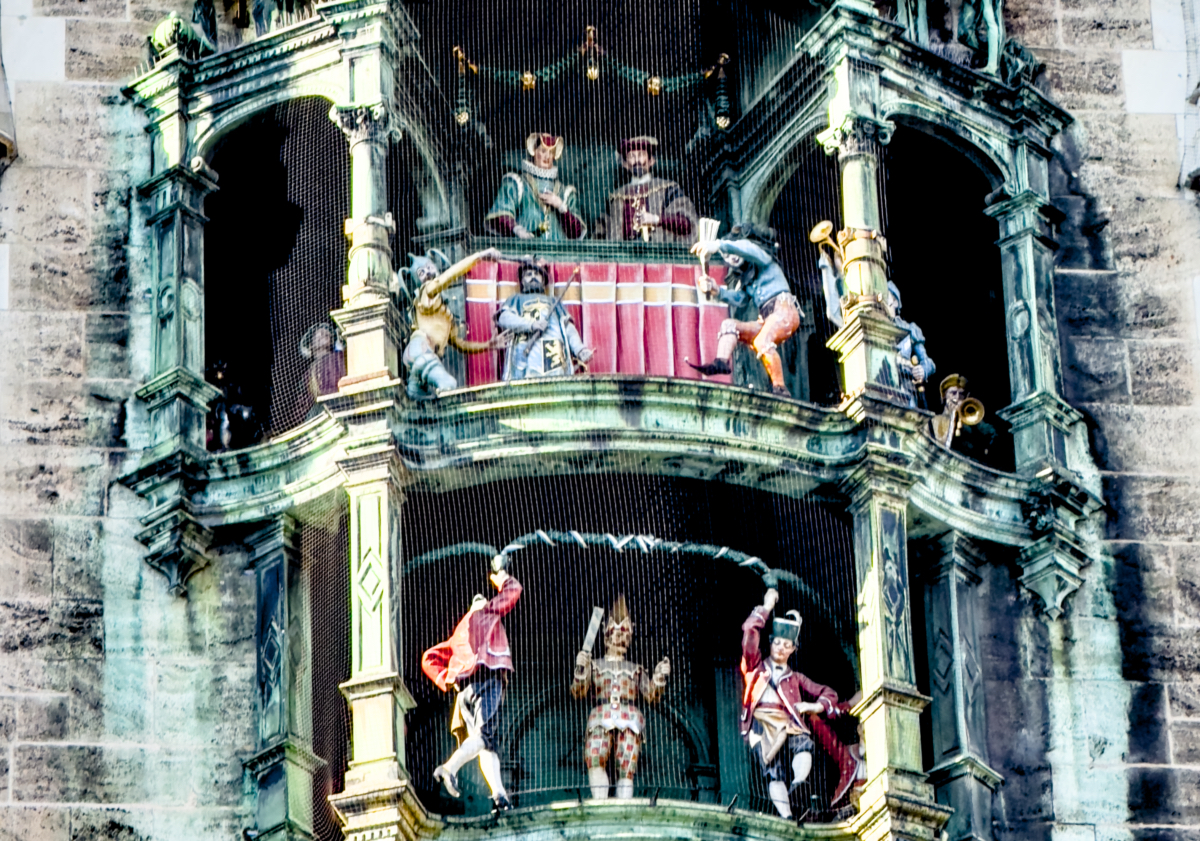
Finally, if you have read all the way to here, you might be interested in the illustrative image for this article: the clock. It is the 16th-century Rathaus-Glockenspiel, on the Neues Rathaus in Marienplatz in Munich. I took this photo last July as I watched crowds stare up passively and consume a story, danced out by 32 life-size figures, of resilience and communal courage. But modern city life rarely embodies the same collective responsibility, and I realized the lessons I’d missed. Public memory vs lived learning; spectacle over practice; power and whose story endures.
For an article about “the wisdom we didn’t earn,” the Glockenspiel is a strong example because it is literally and automatically a mechanical reminder that we mostly treat as background decoration.
So to conclude, every day in Munich, time itself tells a story about how a city survived a plague – barrel makers dancing people back into the streets – and every day, we let the music finish and walk away unchanged.
Automated remembrance without actual learning.
References
References
Why gen AI can’t fully replace us (for now) | Brookings – The empirical literature suggests that tacit knowledge—skills and intuitions gained through experien…
An Aristotelian interpretation of practical wisdom: the case of retirees – According to Tsoukas and Cummings, (1997), Aristotle believed that both craft knowledge (techne) and…
Phronesis vs Episteme: Key Differences in Greek Philosophy – Phronesis is practical wisdom, the ability to determine the right course of action in particular sit…
Tacit Knowledge – Knowing More Than We Realize | Drick Boyd – Polanyi was interested to understand how scientists would “know” when they had hit upon a significan…
Tacit Knowledge – Notre Dame Philosophical Reviews – Finally, it is important to know that Polanyi indicated not only that we know more than we can tell,…
The Fortress of Judgment: What AI Cannot Replace and Why It … – But as a 2025 study in Nature confirms, AI remains “unable to engage in abductive reasoning, grasp a…
The Death of Tacit Knowledge in the Age of Explicit Algorithms – AI capability trajectory: The article presents current-generation AI systems as structurally unable …
Friedrich Nietzsche on Why a Fulfilling Life Requires Embracing … – More than a century before our present celebration of “the gift of failure” and our fetishism of fai…
Robert Bjork: A Teacher’s Guide to Desirable Difficulties – Desirable errors welcome: allow productive failure before correction, Error generation activates ret…
It’s Okay to Fail: How Productive Failure Facilitates STEM Learning … – Productive failure appears to be counterproductive because it has students solve ill-structured prob…
Productive Failure in Education: What Teachers Need to Know – (Kapur, 2008) showed productive failure includes instruction unlike discovery learning. Learners gra…
Demystifying desirable difficulties 2: What they’re NOT – Desirable difficulties are often explained in the context of Vygotsky’s zone of proximal development…
Lev Vygotsky’s Theory of Child Development – Gowrie NSW – Vygotsky’s social development theory asserts that a child’s cognitive development and learning abili…
Zone of Proximal Development – Simply Psychology – Vygotsky’s Zone of Proximal Development (ZPD) refers to the gap between what a learner can do indepe…
[[PDF] Artificial intelligence, cognitive offloading and implications for … – UTS](https://www.uts.edu.au/news/2026/03/experts-warn-unstructured-ai-use-in-schools-risks-cognitive-atrophy/contentassets/ai-cognitive-offloading-and-implications-for-education.pdf) – (2025). Optimizing self-regulated learning: A mixed-methods study on GAI’s impact on undergraduate t…
Balancing AI Learning Gains with Long Term Abilities – LinkedIn – The report’s central finding is what the authors call the “performance paradox.” Students using AI p…
AI’s impact on education: Cognitive offloading and metacognitive … – ” Landmark 2025/2026 studies indicate that students using AI as a “shortcut” perform up to 48% bette…
Ai Makes You Smarter, But None the Wiser – In two large-scale studies, we investigate how AI usage influences users’ metacognitive monitoring a…
AI makes us overestimate our knowledge and performance – WBUR – This research sheds light on the penetrating effects of using AI, and as well as its effect on curre…
Gen Z needs a knowledge base (and so do you) – Stack Overflow – Recently, TD reported that 90% of Zoomers are using AI tools in 2026, a sharp increase from the 76% …
[350+ Generative AI Statistics [January 2026] – Master of Code](https://masterofcode.com/blog/generative-ai-statistics) – In the workplace, 80% of Gen Z professionals use AI for more than half their daily duties, compared …
60% of US Adults Are Using AI These Days – AI Usage Statistics 2026 – 32.7% of people now use generative AI—and adoption is accelerating fast. Explore the latest AI usage…
How Gen Z Is Using AI | Harvard Business Impact Education – Displacing learning by doing: Sixty-eight percent of Gen Z adults are anxious that offloading cognit…
Gallup: Gen Z growing more negative toward AI – K-12 Dive – … AI rules rose from 51% to 74% between 2025 and 2026. Over half of Gen Z K-12 students, 52%, agre…
When AI Promises the World But Can’t Cross the Educational Divide – AI won’t fix educational inequality because AI can’t address the systemic and structural inequalitie…
Seeing: Ruskin’s Response to Spring – The Victorian Web – The greatest thing a human soul ever does in this world is to see something and tell what it saw in …
Polanyi’s paradox – Wikipedia – As Polanyi argues, humans are relying on their tacit knowledge, which is difficult to adequately exp…
Leave a Reply
You must be logged in to post a comment.